Heidelberg Castle, explained
Heidelberg Castle is a Renaissance ruin above the old town, and the everyday castle ticket — sold at the Bergbahn valley station — covers the funicular ride, the courtyard, the Großes Fass and the Deutsches Apotheken-Museum. Only the Friedrichsbau interiors need a guided tour. This page is the whole picture in one read.
I have lived in the Altstadt for over twenty years and walked visitors up to the Schloss in every season, in German and English. The conversation I have most often starts at the bottom of the Burgweg, when someone asks where to buy tickets for the castle rooms. Then I have to explain that the rooms are the one thing the everyday ticket does not include — and that the ticket includes a great deal they were not expecting. This page exists so you hear that before you climb, not after.
Planning your visit?Guided-tour slots are limited — interiors can only be seen on one — and cancellation is free up to 24 hours before. Reserve today, decide later.
Check availabilityGlory, gunpowder, lightning
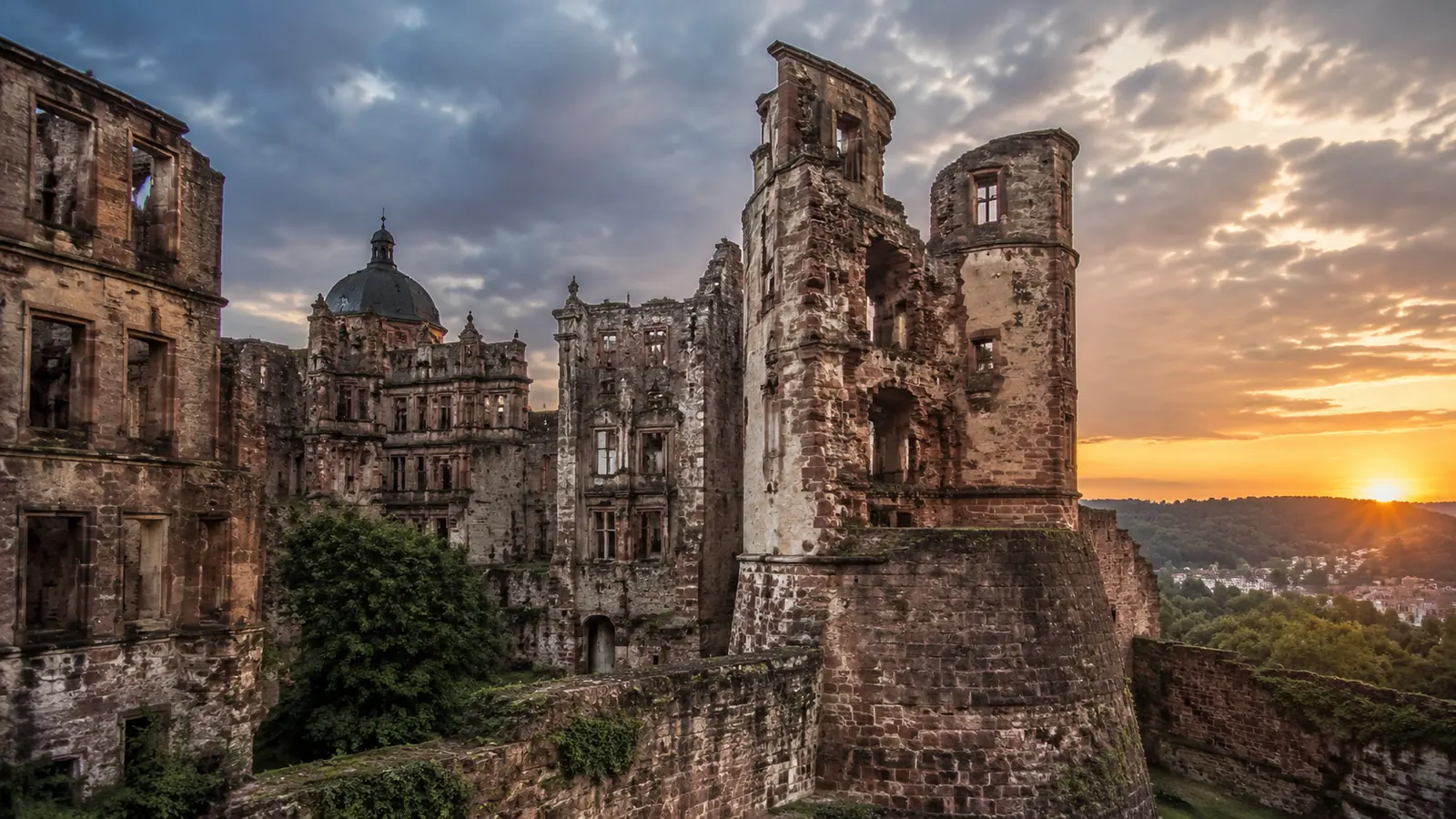
The castle’s story runs in three acts. First the glory: the Prince-Electors of the Palatinate built their residence out from the 1400s, and by the time the Ottheinrichsbau went up in 1556–1559 it carried one of Germany’s finest Renaissance facades. The Friedrichsbau followed in 1601–1607, the Elisabethentor gate went up in 1615 for Elizabeth Stuart, the Winter Queen, and the Hortus Palatinus garden was being called an eighth wonder of the world before war stopped its completion. Second act: French troops wrecked the place in 1689 and again in 1693 during the War of the Palatine Succession, and a lightning strike in 1764 ended every attempt at rebuilding. For decades afterwards, locals carted the stone away for their own houses, until Count Charles de Graimberg started fighting for the ruins in 1810. Third act: the romantics arrived. Goethe came eight times, Turner painted it, and Mark Twain stayed in 1878 and put it in “A Tramp Abroad”. What they loved was precisely the ruin — and I would rather tell you that plainly than let you arrive expecting an intact palace. The long version is on history and destruction, including why the ruin stands over an undamaged baroque old town: Heidelberg had no heavy industry and came through the Second World War essentially untouched.
What the ticket does, and does not, buy
The standard castle ticket is sold at the Bergbahn valley station at Kornmarkt, and it bundles more than most people expect: the funicular ride, the courtyard with those facades, the Great Tun — the 1751 barrel in the cellar, about 220,000 litres, once guarded by the court dwarf Perkeo — and the German Pharmacy Museum. Courtyard entry rarely sells out; I have never seen anyone turned away for lack of a ticket. What the ticket does not buy is the thing many visitors think they are buying: a walk through furnished castle rooms. The Friedrichsbau state rooms open only on a guided tour, run several times a day in German and English on a schedule that shifts with the season, and those slots are limited. What the interiors actually show is worth reading before you decide whether to add the hour. The garden terraces cost nothing at all during daylight — and audioguides exist in eight languages if you go without a guide.
Funicular or the Burgweg
Everyone asks about the cable car. It is a funicular railway, the Bergbahn, and the lower line from Kornmarkt is included in your castle ticket; the separate upper line to the Königstuhl still runs wooden cars from 1907. On foot, the Burgweg from Kornmarkt takes 10 to 15 minutes — short, steep and cobbled, so I send anyone with good knees up the path and back down by rail, or the reverse. The full comparison, including the Schlangenweg switchbacks and accessibility notes, is on funicular or on foot.

The decision that actually matters
Not “tickets or no tickets” — which way to see it. With the standard ticket you wander self-guided, which suits people who mainly want the terrace view and the barrel. A guided tour adds the context a ruin badly needs; the 2-hour walk I list covers the Bergbahn, courtyard, Great Tun and pharmacy museum with a guide doing the explaining. Families and small groups often do better on the per-group Electors tour, and a private guide folds the Philosophenweg, the Alte Brücke and the old town into one three-hour sweep. Staying in Frankfurt without a car, the 5.5-hour day trip handles the transport. All six options sit side by side on the tickets and tours page; what moves the price of each — season, group size, private versus shared, transport bundled or not — is on what admission costs. I print no figures; the live price for your date is in the booking panel.
When to go
The courtyard is open daily 9:00 to 18:00, last admission 17:30, year-round. The crush is midday June to September and during December’s Christmas markets; mornings before 10:30 are calm, and that is when the Bergbahn queue at Kornmarkt is shortest. On the three summer Saturdays of the Schlossbeleuchtung fireworks, the riverbanks fill early. My standard prescription for one day: castle in the morning, old town and lunch after, the Alte Brücke, then the Philosophenweg at golden hour for the classic panorama from the far bank — laid out hour by hour on one day in Heidelberg. However you come up, take the terrace slowly. The ruin has been earning its visitors for two hundred years; it will wait while you look.
Ready to book?
The panel below shows live availability for the two-hour castle tour I send first-time visitors on — funicular ride, courtyard and Pharmacy Museum included. If you would rather compare everything first, start with all tickets & tours or the honest reviews.
Frequently asked questions
Do I need to book Heidelberg Castle in advance?
For the courtyard, no — the ticket is sold at the Bergbahn valley station and rarely sells out. What does fill up are the guided slots: the interior tours and the bookable tours listed on this site. Details on buying tickets.
What does the standard castle ticket include?
The Bergbahn ride between Kornmarkt and Molkenkur, the castle courtyard, the Großes Fass cellar and the Deutsches Apotheken-Museum. The furnished Friedrichsbau rooms are extra, on a guided tour only.
How long does a castle visit take?
Plan 1.5 to 2 hours for courtyard, terrace, barrel and museum; add about an hour if you take the interior tour. The full arithmetic is on how much time to plan.